Web: www.fishfoto.com -- E-Mail: fish@flyingwithfish.com
29/10/2008 - LH Pt 1: Lufthansa To Control BMI & Become 2nd Largest At Heathrow While Also Trimming Expansion
As Lufthansa's (LH) net profits fall 75% in the 3rd quarter of 2008 and it cuts it spending by US$318mil, the airline has announced it will be purchasing the controlling stock of BMI/British Midland (BD) for £320 (US$511mil).
Lufthansa currently owns a 30% (minus 1 share) and SAS owns a 20% share in BMI, while BMI Chairman Sir Michael Bishop controls 50.1% of BMI's shares. This sale will give Lufthansa not only 80% control over BMI, but it will also give Lufthansa substantial access to the highly sought after, and financially valuable Heathrow slots.
Once the deal to take over the controlling stock is completed by the 12th of January 2009, following regulatory approval, Lufthansa will control 11% of London Heathrow's landing/departure slots.
What I find most interesting about this sale of Sir Michael Bishop's shares is Airliner World's report in August of 2008 on the profitable BMI that states the following after an interview with Sir Michael Bishop " A year ago it seemed likely that the venerable knight would decide it was time to call it a day. But 12 months is a long time in the aviation business and Sir Michael may put off selling the airline for another two or three years in the hope that the economic climate will improve."
I know that 3 months is a long time in the airline industry, that that quote following the interview leaves a lot of room for question, however BMI has remained profitable and expanding as an airline. In the face of British Airways slashing UK domestic service, most notably service in Scotland, BMI has remained solid in providing domestic service to 10 significant airports within the United Kingdom.
As a member of BMI's Diamond Club, one of the most generous frequent flyer programs available within the Star Alliance, I have to wonder how long it will take for Diamond Club to become Lufthansa's Miles & More frequent flyer program.
Lufthansa's Miles & More frequent flyer program is currently used by not only Lufthansa, but also Swiss International Air Lines, Austrian Airlines, LOT Polish, Air One, Croatia Airlines, Adria Airways and Air Dolomiti.
This take over of BMI's controlling stock will be interesting to watch. It is likely that Lufthansa will reallocate a number of landing slots to Lufthansa flights to maximize their potential usage of the Open Skies agreement.
Hopefully BMI will remain BMI, flying BMI colours, and continue to expand. The airline has seen significant growth in the past few years and has been building its route structure with the acquisition of B-Med from British Airways. It would be shame to see this airline lose its identity and fade fully into Lufthansa.
Happy Flying!
Showing posts with label London Heathrow. Show all posts
Showing posts with label London Heathrow. Show all posts
29 October 2008

27 October 2008
Can Heathrow Be Replaced By A Man Made Island Airport?
Web: www.fishfoto.com -- E-Mail: fish@flyingwithfish.com
27/10/2008 - Can Heathrow Be Replaced By A Man Made Island Airport?
For those of you who have read Flying With Fish regularly since its inception, you may be aware of my affinity for London Heathrow Airport (LHR). I have slept at Heathrow more than any other airport, due to a combination of missed connections, weather cancellations and my being to cheap to pay for a hotel room.
I think if I sleep in LHR's Terminal 3 one more night the BAA might have a plaque with my name on it made up and placed on a bench near the Air Canada check-in counter.
Today's edition of The Independent reports that the Mayor of London Boris Johnson is reviving the idea of constructing an airport on a man made island off the Isle of Sheppey in the Thames Estuary. Under Johnson's concept the airport would be constructed in waters 10-to-13 feet deep and be expanded to include six runways.
The cost of replacing the 62-year-old Heathrow, which is a major established international hub? An estimated £40bil (US$61,854,790,607)
Should the British Government go ahead and choose to move London Heathrow to the Thames Estuary there will be some significant hurdles. Having read, and reread, this story a few times today I came up with a few things that the planning commission will need to keep in mind off the top of my head.
First and most importantly they need to remember the problems associated with the construction of, and sinking of, Osaka's Kansai International Airport (KIX), which opened in 1994. While KIX was built on reclaimed land in much deeper water, engineers misjudged the actual rate of settling/sinking of the island. The man made island KIX is built on has already settled far below the estimated 20 year sinking estimate. The island KIX is on is now at 15 feet above sea level, and continues to sink at 4cm per year, or 33 feet over 20 a year span (keep in mind the island is now only feet above sea level).
As the island sinks, it is drops at a rate faster than that of the 5,577 foot long terminal. This disparity in sinking rates requires that the terminal be jacked up off the foundation. The jacking of the terminal allows the terminal to stay level and not crack and separate in specific areas.
Given the traffic Heathrow receives compared to KIX, the island would need to be much larger than the one for KIX. Heathrow moves an average of 67.5million passengers annually, while KIX only moves an average of 17.5 million passengers per year. For comparison, Hong Kong International Airport (HKG) 'only' moves approximately 44 million passenger a year, still 23.5 million less than Heathrow (London Standsted alone moves an average of 23.7 million passengers per year)
The sheer size of an island to be created, placed over bedrock, and constructed would be a massive undertaking. This undertaking needs to factor in that five international airports serve London. While the idea of phasing out Heathrow may seem logical, the airport cannot easily be replaced. The passenger traffic can be moved, in part, to another London area airport.
While London Gatwick (LGW) is semi-convenient to London, the airport is restricted to a single runway. While there have been studies to add a second runway to Gatwick, the additional runway cannot be constructed prior to 2019.
Despite LGW being confined to a single runway for both departures and arrival, the airport moves an average of 263,363 aircraft annually, or 721.5 aircraft daily, or 30 aircraft per hour. For a single runway airport LGW does moves an incredible amount of traffic, but the airport is at capacity and cannot be used to reduce Heathrow's traffic.
Like Gatwick, London Stansted (STN) is a single runway airport, but it has room for two additional runways. The plans are currently being reviewed, despite some opposition to expand Stansted's boundary. This expansion would allow fro runway #2 (and potentially #3). Stansted could have a 2nd runway as early as 2011.
I have long since voice my opinion that STN could be an alternative use for Heathrow airport. Although STN could never replace LHR or handle the traffic LHR moves. With a second runway Stansted could potentially handle up to 10mil more passengers than it handles now, reducing some traffic from Heathrow. This reduction in traffic can allow more slots to be opened at LHR.
Heathrow has aggressively been campaigning for a 3rth runway that would be significantly shorter than the two current runways. This third runway could ease congestion with the constant stream of regional narrow body flights and regional traffic. This new third runway Heathrow would be able to accommodate 720,000 movements annually or 1,972 flights per day.
So could London Heathrow be moved to an Island that could offer six runways? I am sure it could be done. The Egyptians constructed the Pyramids and a blind Chinese monk named Haitong started construction of the world largest Buddha in Leshan, China, in 713AD. With these massive accomplishments in mind, I am sure London could relocate Heathrow to a man made island.
Happy Flying!
04 July 2008
Why Can't I Fly When I Want To Fly?
Web: www.fishfotoworldwide.com -- E-Mail: fish@flyingwithfish.com
4/07/2008 - Why Can't I Fly When I Want To Fly?
A question commonly asked by travelers is "Why can't I fly when I want to fly?"
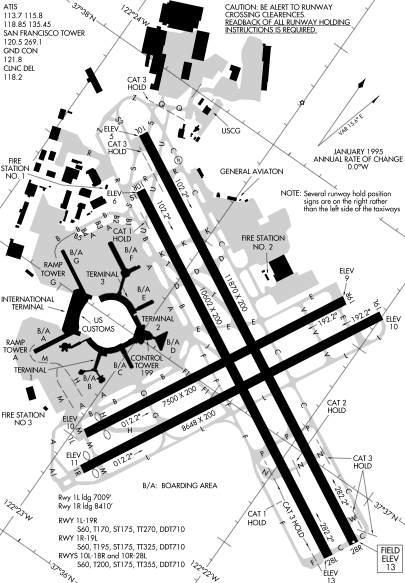
As I sit here on a wall, on the edge of the San Francisco Bay, looking out over San Francisco (SFO) Int'l Airport's tandem runways (28L/28R) watching the early morning west coast-to-east coast transcontinental flights line up and depart I decided this was a good time to answer this question.
In the past month I have received a number of e-mails from photographers seeking to find out why they can't fly certain routes at certain times of the day that are convenient to them. I'm not sure why there has been an influx of this question, but clearly this is a question on many people's minds.
In reality there are dozens of answers to this question depending on each individual scenario. But in many cases the reason why people cannot fly when they want to fly has to do with two factor
1) Length of Flight
2) Time-Zone Shifts
When airlines plan their routes they have to account for simple factors such as departure and arrival time. A good example of this is flights between New York's JFK (JFK) and London's Heathrow (LHR). For travelers there are only two times of the day you can fly this route, between 7:30am and 9:00am or between 6:00pm and 11:30pm. Conversely for those seeking to fly from Heathrow back to JFK they can depart nearly all day long from 8:30am until 8:05pm with flight never really more than 90 minutes apart.
Why can you only go to London in the early morning or the evening and return all day? Simple, it involves traveling with the time zones. If you depart JFK at 10:00am you'll arrive at 10:00pm, which is why many business travelers often fly out around 6:00pm or 7:00pm to arrive in the morning at the start of the business day. These times are because you are flying east, which are 'against' the time-zones.
When you fly 'against' a time zone is when you are flying in a direction that adds time to your day. If you depart JFK at 8:30am, it is already 1:30pm at LHR. The average flight time between JFK and LHR is 7hrs 30min (flight times depends on the type of aircraft flown, such as 777-200 takes 7hrs 25min while a 757-200 may take 8hrs, then you factor in the airline's 'blocked flight time', etc etc). So if you're 8:30am departure is really a "1:30pm departure" puts you in at 9:00pm, or approx 12hr 30min after you departed instead of 7hrs 30min after you departed.
If an airline were to offer a 2:00pm flight between JFK and LHR you'd arrive around 2:00am the following day. This would mean passengers would arrive in a closed airport with no service between the airport and the city, leaving passengers stranded for 3 hours waiting for the airport to open again.
The return flights are easier to manage because flights headed west are flying "with the time zone." A flight departing LHR at 8:30am arrives at a reasonable 11:00am and an 8:00pm departure also arrives at a reasonable 10:30pm
If you watch airports departures during the day you see a shift in 'tails' and aircraft routes throughout the day. Yesterday at SFO looking out I noticed the Japan/China/Korea flights all depart in clusters, right around the same time the Paris/Amsterdam/Dublin/Frankfurt/London flights arrive in the afternoon. Around this time you starts watching the north-south traffic and 'mid-continent' flights increase. It is not random that the majority of the airlines flying certain routes operate on very similar schedules. These airline are all fighting the same forces of 'linear time & time-zones." An airline's schedule must not only meet passenger needs, but also the logical need to depart and arrive within a practical time period.
I won't get into the factor of the international dateline combines with time zones but I will say this......I always love flying from Nagoya, Japan (NGO) to Honolulu, Hawaii (HNL) and landing 12 hours before I have taken off (aren't time zones and the international date line fun?).
.................Keep this in mind when you fly from New York's JFK to Los Angeles' LAX on a business trip and have a multitude of options in the morning, but get frustrated when you're trying to book a late afternoon flight from LAX back to JFK and you can't find any flights available.
.........and for no reason at all, at the end of the post is a photo I shot from the wall I am sitting on of a Northwest Airlines Airbus A319 climbing out off of SFO's Runway 28L in front of the San Francisco skyline
Happy Flying!
--Click Image To Enlarge It--

02 May 2008
2/05/2008 - Weekly Roundup: Foreign Currency Exchange Tips; London Heathrow Isn't That Bad; Resources For Traveling Photogs
Web: www.fishfotoworldwide.com -- E-Mail: fish@flyingwithfish.com
2/05/2008 - Weekly Roundup: Foreign Currency Exchange Tips; London Heathrow Isn't That Bad; Resources For Traveling Photogs
This week's weekly round up is being written from the Air France Arrivals Lounge at Paris's Charles de Gaulle International Airport (CDG), in Terminal 2C. I always love the way each terminal at CDG is named, there is a Terminal 1 and a Terminal 3, however there are also Terminals 2A, 2B, 2C, 2D, 2E, 2F. Each is it's own free standing terminal.....yet they are all numbered "2." I love checking in for a flight online and at times it will simply say "Terminal 2" which narrows it down to six potential terminals. Easy, eh?
Enough about CDG and onto the week in review. This week was a light week, but here goes the quick recap.
For those of you traveling internationally, you can learn how to maximize your currency exchange in this past Monday's post : 28/04/2008 - Foreign Currency Exchange : Get The Most Value For Your Money
At the start of the week an American Airline's European customer service chief, Don Langford, stated that London Heathrow (LHR) is the worst airport in Europe, and referred to this popular international hub as a 'bit of a dump.' While I agree with some of what Mr. Langford is saying, I also respectfully disagree and actually enjoy LHR. You can read my comments on Mr. Langford's statement here: 29/04/2008 - London Heathrow Branded As "Worst Airport In Europe," I Think Not!
Finally I rounded out the light week with some information that can help a photographer on the road. In fact most of the information in Thursday's entry on Flying With Fish will help any traveler on he road, not just the photographers. You can see some of my most used resources in this entry: 1/05/2008 - Resources For The Traveling Photographer : Some Quick Links
I am off to shoot an assignment in the City of Lights for the next three days.
Happy Flying!
29 April 2008
London Heathrow Branded As "Worst Airport In Europe," I Think Not!
Web: www.fishfotoworldwide.com -- E-Mail: fish@flyingwithfish.com
29/04/2008 - London Heathrow Branded As "Worst Airport In Europe," I Think Not!
Can a bad airport also be good? This is a tricky question, but in regard to London's Heathrow Airport (LHR) I think an airport that has recently been referred to as "The Worst In Europe" (have they been to Rome's Leonardo da Vinci - Fiumicino Airport, aka: FCO?) can also be a good airport.
I see the downside of London Heathrow. The airport is a bit run down; it has high delays; it could use a 3rd runway to reduce congestion; the opening of the new Terminal 5 was a disaster; immigrations takes longer than some flights (unless you are in business/first class on an airline that pays for the Fast Track); there is a significant homeless population who live in Heathrow; the cost of transiting Heathrow is more expensive that transiting through other European hubs............ and the top "downside" to Heathrow is probably that Immigrations Officers always seem so grumpy with the asking of questions, as if every foreign traveler is seeking to enter the country under false pretenses.
With the downsides of Heathrow out of the way, I am going to buck the trend, go out on a limb and also say that I also see the airport's upside. For starters, I like Heathrow. Overall I find Heathrow to be one of my five favourite airports to be stuck in, have a long layover in and even to sleep in when I have a "missed connection." I know most people don't view airports this way, but I have slept in Heathrow more than any other airport, with the exception of San Francisco International Airport (SFO).
Despite a large, and growing, homeless population Heathrow is a safe airport. Those who are homeless and stay in Heathrow tend to try and act like travelers so they will no be thrown out by the police. The homeless in other airports tend to not blend in, and from my experience tend to be more prone to criminal activity than those at Heathrow. I have been approached by people begging at London Gatwick (LGW); been solicited for drugs at Newark's Liberty Int'l Airport (EWR); woken up to find a homeless man peeing on the wall a few feet from my head at Paris' Roissy Charles de Gaulle Int'l Airport (CDG); watched a clearly homeless and mentally ill woman picking through the trash at Philadelphia International Airport (PHL), but at London's Heathrow there is none of that.
For very long layovers the Heathrow Express is a convenient way to get into the city for a few hours. To lighten your load if you misconnect and have to spend the night, Heathrow has very convenient "Left Luggage" operations to store you bags for a few hours, or overnight. To go plane-spotting to kill time the parking garages have quite a few good vantage points for the operations. For long walks, to kill time, most terminals are connected via underground passage ways which makes walking between terminals a breeze.
Overall I have had some of the best long conversations in the middle of the night on topics ranging from foreign policy and economics to choice of computer operating system while sitting in Heathrow. People in airports tend to either be a "pack mentality" or open and welcoming in conversation. In general conversations at Heathrow tend to be more in depth, more intellectual. I am sure it is a fluke this happens at one airport more than another, but it does......and I have extensive experience sleeping in airports all over the world for various reasons.
From a business stand point, Heathrow is the airport all the airlines want to fly into. Yes, London has five commercial airports, yes four of them can handle long-haul international traffic, yes two of them handle a significant amount of international traffic, but overall Heathrow is the one that business travelers tend to use. It is probably because of the train that departs for Central London every 15 minutes. It could be the considerable number of international airlines that fly into Heathrow, it may be that you can fly nearly anywhere in the world from Heathrow (many of those places non-stop) , it could also be that many long-haul airlines have "arrivals lounges" that allow passengers to freshen up upon arrival before heading out to meetings, or it may be that many airlines that call Heathrow home have top-notch departures lounges for their frequent flyers that have significant amenities over those offered at Gatwick.
I think that anyone who calls Heathrow the 'worst airport in Europe' needs to check out the facilities at Paris' Roissy Charles de Gaulle Int'l Airport (CDG), Rome's Leonardo da Vinci - Fiumicino Airport (FCO) and Moscow's Sheremetyevo Airport (SVO) in terms of not only on-time arrival/departure but also ease of transit to the city, safety of delayed passengers, access to electrical outlets and ability to sleep before branding Heathrow as the worst.
So, can an airport that is being referred to as the 'worst airport in Europe' be good? I think it certainly can be.
Happy Flying!
Subscribe to:
Posts (Atom)